
Safety Gear
U.S Coast Guard Requirements
Most work on the farm takes place in boats or on floating rafts. Farms should set and enforce consistent boat handling and maintenance protocols that are company-specific while still complying with basic boater safety regulations. Employees should be trained in vessel operation and all vessels and rafts should be equipped with a first aid kit and appropriate safety gear.
The U.S. Coast Guard requires specific safety gear depending on the vessel’s size, however it is good practice to ensure that all boats are equipped with first aid kits, an oar, spare line, bailer, gaff hook, anchor, and emergency food and water.

Coming prepared is best practice on the farm. Employees should bring an extra layer, foul weather gear, rubber boots, gloves, sun protection, food, and water each day. Not only does this improve morale on the farm but it instills responsibility and dependability among the crew.
Vessel Documentation:
All vessels with auxiliary power must be registered annually with the state. Once registered, a validation sticker and the registration numbers must be displayed on both sides of the vessel’s bow. Owners are also required to pay the state excise tax for each registered vessel. Registration requirements and fees vary by state. Visit the Maine Department of Inland Fisheries and Wildlife for more details on Maine’s regulations.
Numbering Requirements for the state of Maine:
- Numbers must be fixed to both sides of the bow
- Numbers must read from left to right
- Numbers must be at least 3-inch high BLOCK lettering
- Letters and numbers must be separated by a space
- The registration sticker must be affixed on both sides of the bow three inches to the right of the number.

Required Equipment:
PFDs (Personal Floatation Devices): all vessels must carry a minimum of two U.S. Coast Guard-approved Type I or II PFDs or at least one for each person on board. Boats over 16 feet must also carry one throwable (Type IV) PFD. Children 12 years of age or younger must wear a PFD at all times. PFDs must be easily accessible, appropriately sized, and in serviceable condition.
You can visit that website here!
Visual Distress Signals: Vessels over 16 feet operating in waterways greater than two nautical miles wide are required to carry USCG-approved visual distress signals. These may include pyrotechnic signals (flares, launchers, smoke signalers), distress flags (day-time only), or electrical distress lights. Expired signals may be retained as spares but will not be counted towards USCG requirements.


Fire Extinguishers: The USCG requires that all vessels with an inboard engine carry a hand-portable Type B fire extinguisher. Vessels with closed living spaces, permanently installed fuel tanks, or closed compartments for storing fuel or flammable substances must also carry a Type B extinguisher. The number, size, and type of extinguisher depends on the length and type of vessel.

Ventilation: Vessels that use gasoline must have a ventilation system consisting of a duct/cowl (an opening) that allows outside air or air from a ventilated compartment to flow into the engine area, and an exhaust opening to another ventilated area. Alternatively, a powered ventilation system (typically exhaust blowers) may also be used. Vessels powered by outboard engines are exempt from this requirement.
Backfire Flame Arrestors: All inboard gasoline engines installed in vessels must have a backfire flame arrestor on each carburetor.
Sound Producing Devices: It is a good idea for all vessels to carry a whistle and fog horn. The USCG requires all vessels over 40 feet to carry a whistle.
Navigation Lights: The USCG requires vessels less than 40 feet to display navigation lights (port and starboard running lights) between sunset and sunrise and during the day when visibility is obscured by fog, rain, or haze.
Pollution Regulations: Federal regulations prohibit disposal of any type of waste (trash, oil, liquid pollutants etc.) into U.S. Waters. Vessels with machinery spaces that are 26 feet or greater must display a pollution placard (see Figure 2) in the vessel. The placard must be durable, at least 5 x 8 inches, and placed in a conspicuous space.

Garbage Disposal: Discharge of plastic waste into the ocean is prohibited. Vessels that are 26 feet or longer must display a placard outlining discharge regulations. The placard must be durable and at least 4 x 9 inches.

For regulations outlining discharge of other waste, see the chart below:

Human Waste Regulations: The FDA stipulates through the National Shellfish Sanitation Program that all vessels be equipped with a MSD (marine sanitation device) to dispose of human waste. If a marine head is not feasible, a tight sealing 5-gallon bucket will suffice so long as it is properly labeled “human waste.” As shown below.
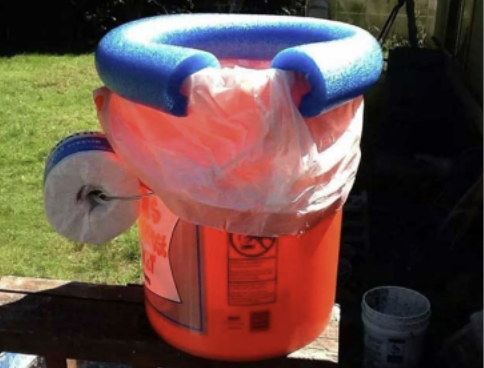
Photo credit: Maine DMR
