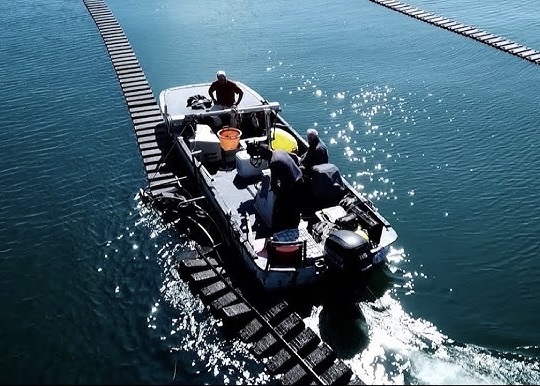
"Shell-ebrate!" Maine's K-12 Bivalve Aquaculture Curriculum
About the Bivalve Aquaculture Curriculum
In Maine, when we talk about aquaculture we often end up talking about bivalves. Whether it is oysters, mussels, scallops, or clams, bivalve aquaculture is central to Maine’s farmed seafood industry. To build a basis for understanding how we farm these different organisms, it is important to understand their biology. What environment do they live in? What do they eat? How do they reproduce and when? In this curriculum, we cover these questions as we “crack the shell” on bivalve aquaculture and bring students on a fantastic journey from the hatchery to the table!
If you have a resource you would like added to the website or if you have feedback on an existing lesson, we are happy to hear from you. Please fill out the form below!
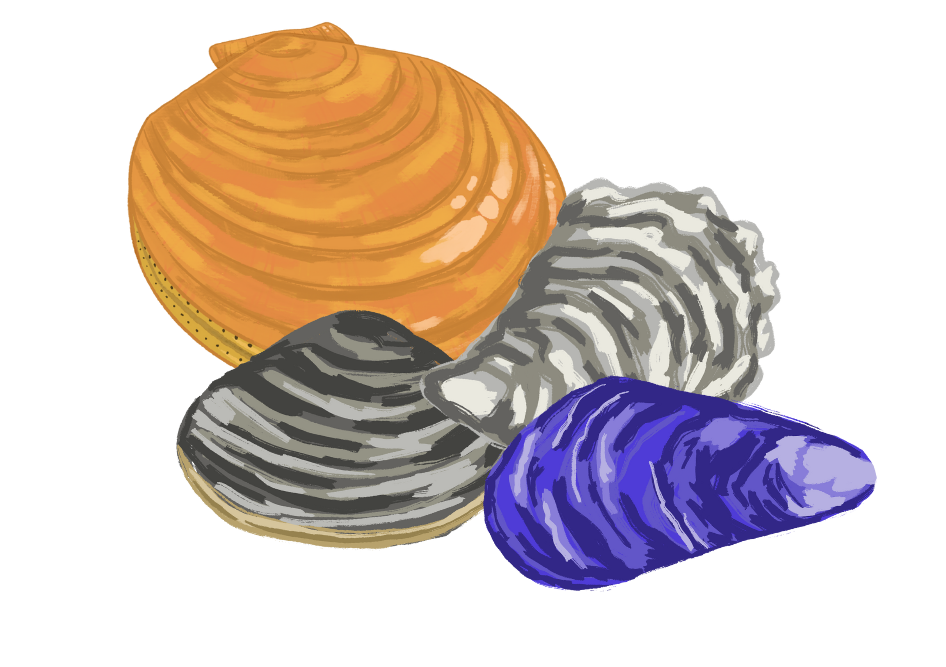
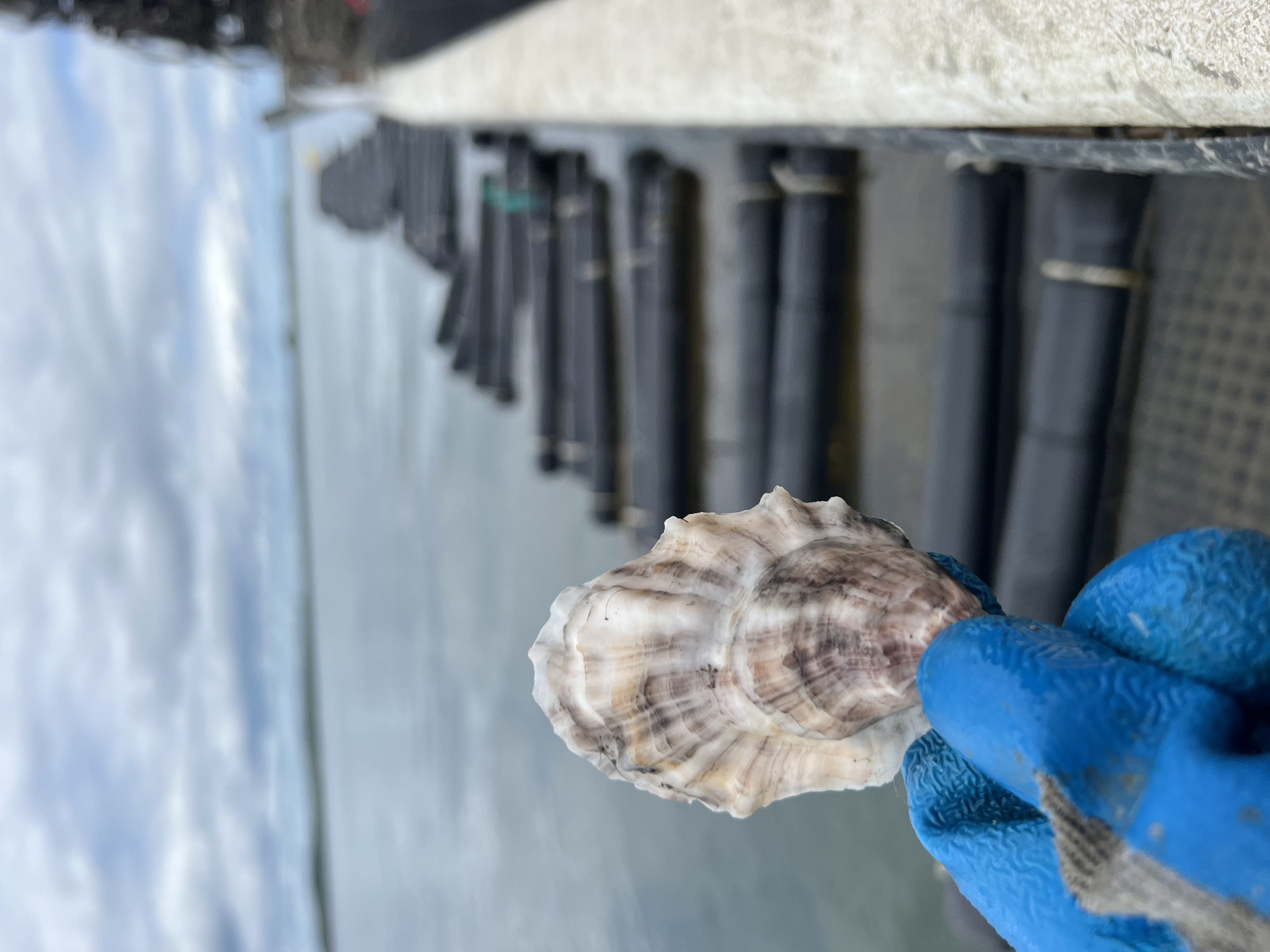
Supported by the United States Department of Agriculture- National Institute of Food and Agriculture- Agriculture and Food Research Initiative, project award no. 2024-67037-42603
Unit 1: Dive into Bivalve Aquaculture!
What is a “bivalve,” what bivalves do we farm in Maine, and how do we grow these salty, shelled critters? This unit is a great introductory unit or stand alone resource for exploring the world of bivalve farming with students. Whether you plan to teach the whole curriculum or you would like to spend just a couple of class periods covering the basics, we recommend starting here!
*Lesson 1: Introductory Activity
What are bivalves (oysters, mussels, clams, and scallops), and how might we farm them in Maine?
~~~
In this lesson, students will learn what a bivalve is and imagine what a bivalve farm might look like. With no prior knowledge needed, students are encouraged to begin thinking about how “aquaculture” is practiced by drawing and sharing their ideas of a farm. Students then collaborate to discuss what they know, what they have heard, and what they would like to learn about bivalve farming. Finally, students see images of farms and reflect on their thoughts as a group.
Grade: 3-12
Time Frame: 60 minutes
Prerequisites: None
Standards:
ES: 3-PS2-4, 3-LS1-1, 3-LS3-1, 3-LS3-2
MS: MS-LS1-1, MS-LS1-2, MS-LS2-1, MS-ETS1-1, MS-ETS1-2
HS: HS-LS2-1, HS-LS2-7, HS-ETS1-1
*Lesson 2: Define Bivalve Aquaculture
What does bivalve farming in look like in Maine?
~~~
In this lesson, students will build their understanding of bivalve aquaculture by learning about a specific form of bivalve aquaculture in Maine: oyster, blue mussel, or sea scallop. Students will then consider how to communicate what they have learned to an audience with no prior knowledge of bivalve aquaculture. Finally, groups will put their creative communication skills to the test by making bivalve farming PSAs!
Grade: 6-12
Time Frame: 60 minutes
Prerequisites: Lesson 1 recommended
Standards:
MS: MS-LS1-1, MS-LS1-2, MS-LS2-1, MS-ETS1-1, MS-ETS1-2
HS: HS-LS2-1, HS-LS2-7, HS-ETS1-1
*Lesson 3: Maine Aquaculture Scavenger Hunt
How does bivalve aquaculture fit into the geography of coastal Maine?
~~~
In this lesson, students practice their exploratory skills using digital maps to located different features, farms, and facilities along the Maine coast. Students will have the opportunity to work independently and in groups before contributing to the collective class product, a map of Maine bivalve aquaculture.
Grade: 6-12
Time Frame: 100 to 120 minutes
Prerequisites: Lessons 1 & 2 recommended
Standards: Maine Learning Results Social Studies (Geography & Civics), Science & Engineering, Technology & Digital Literacy, NGSS
Video 1: Dive into Bivalve Aquaculture
This video is an introduction to bivalve farming in Maine. It is associated with lesson 2 of this unit! Designed for 6-12th grade by the Maine Aquaculture Innovation Center.
Unit 2: Bivalve Biology & Anatomy
What parts make up a bivalve and what does this animal’s life cycle look like? In this unit, students learn about the structure and function of different organs in the bivalve’s body before exploring how bivalves grow and reproduce. With this background understanding, students then connect the bivalve’s life cycle with the hatchery process to understand how and why we grow bivalves in a hatchery during their early life stages!
Lesson 1: Bivalve Blueprint - Anatomy
What is the anatomy of a bivalve (oyster, mussel, clam, or scallop) and how are the bivalve species similar and different?
~~~
In this lesson, students will investigate the anatomy of four different Maine bivalves that are found in the wild and on aquaculture farms. First, students will practice developing models or visual representations of these bivalves. Then they will explain to their classmates how the organism’s features support survival and growth during a ‘museum walk’ activity.
Grade: 6-12
Time Frame: 3-4 class periods ( 180 minutes total)
- NOTE: Completing a dissesction such as this one from Maryland Sea Grant is an abbreviated way to be introduced to bivalve anatomy. Another alternative is to watch the bivalve dissection videos referenced in the lesson plan for each of the four species farmed in Maine.
Prerequisites:
Unit 1: Lessons 1, 2, and 3 are recommended to complete this activity
Standards:
- MS: MS-LS1-1, MS-LS1-2, MS-LS2-1, B1-Structure and Function, B2-Ecosystems, E1-Systems, A1-Unifying Themes
- HS: HS-LS1-2, HS-LS4-2, B1-Structure and Function, B2-Ecosystems, B3-Evolution, E1-Systems
Lesson 2: Cracking the Code - Life Cycle
What is the life cycle of a bivalve (oyster, mussel, clam, or scallop) and how are bivalve lifecycles similar and different across species?
~~~
In this lesson, students will investigate the life cycle of four different Maine bivalves that are found in the wild and on aquaculture farms. Students will begin by developing models or visual representations of bivalve life cycles to relate survival to adaptation and evolution in marine environments. Then they will teach each other about the bivalve species they have become an expert in.
Grade: 6-12
Time Frame: 2 class periods ( 90 minutes total)
Prerequisites:
Unit 1: Lessons 1, 2, and 3 are recommended to complete this activity.
Unit 2: Lesson 1 is required to complete this activity.
Standards:
- MS: MS-LS1-1, MS-LS1-2, MS-LS2-1, MS-LS4-4, E1 Systems, E2 Biodiversity, B1 Skills & Traits of Scientific Inquiry, B2 Scientific Reasoning
- HS: HS-LS1-4, HS-LS2-6, HS-LS4-4, E1-Systems, E2 Biodiversity, B1 Skills & Traits of Scientific Inquiry, B2 Scientific Reasoning
*Lesson 3: What Happens in the Hatchery?
What happens in a bivalve hatchery, and how is this related to the bivalve life cycle and anatomy?
~~~
In this lesson, students will be introduced to the concept of bivalve hatcheries and watch a video about the Downeast Institute Hatchery on Beals Island to see how bivalve seed is produced in Maine. Then they will connect what happens in the hatchery with the life cycle of a bivalve.
Grade: 6-12 (easily adapted for 3-5)
Time Frame: 1-1.5 class periods (60 minutes total)
Prerequisites:
Unit 1: Lessons 1 and 2 are recommended.
Unit 2: N/a
Standards:
- MS: MS-LS1-12 MS-LS1-4, MS-LS2-1, MS-ETS1-1, MS-ETS1-2
- HS: HS-LS1-2, HS-LS1-4, HS-LS2-7, HS-ETS1-1
Extension: 45 Minute Hatchery Tour (Video & Interview)
https://www.youtube.com/watch?v=yQ57B3N1ELo
Video 2: Basics of Bivalve Biology
This video is an introduction to bivalve hatcheries in Maine and how the anatomy and life-cycle of bivalves relate to hatchery processes. It is associated with lesson 2 of this unit! Designed for 6-12th grade by the Maine Aquaculture Innovation Center.
Unit 3: Maine’s History of Bivalve Aquaculture
There is a rich history of fishing and farming in the waters of the place we call Maine. How do bivalves and bivalve aquaculture fit into this context? In this unit students have the opportunity to explore how Wabanaki communities historically harvested shellfish and how the relationships between people and bivalves remain important in Wabanaki culture today. Students also learn how commercial bivalve aquaculture in Maine has emerged in the same waterways where shellfish have been harvested for millenia.
1. Wabanaki Shell Mounds Unit: Maine Department of Education
This Unit from the Maine Department of Education (DOE) Wabanaki Studies Program is recommended as the first lessons for Unit 3: Maine’s History of Bivalve Aquaculture. The Maine Aquaculture Innovation Center (MAIC) is grateful to the Wabanaki Studies Program and the DOE for the creation of this important resource and for allowing us to link to it in our curriculum. For additional resources for educators teaching Wabanaki Studies, please visit: https://www.maine.gov/doe/innovation/wabanakistudies.
~~~
Grades: PK-12
*Lesson 2: Maine’s Brief Oyster History
If oysters were once so abundant that they “obstructed shipping” in some New England rivers, why did they nearly disappear from Maine, and how have people tried to bring them back?
~~~
In this lesson, students will will act as “history detectives,” using primary documents to track the abundance, decline, and rebirth of Maine oysters.
Grade: 6-12
Time Frame: 1 class periods (60 minutes total)
Prerequisites:
Unit 1: Lessons 1, 2, and 3 are recommended to complete this activity.
Unit 2: N/a
Unit 3: N/a
Standards:
- MS: MS-LS2-1, MS-LS2-4, MS-ESS3-3, MS-ESS3-4
- Social Studies: History 1 (Interpreting Change), History 2 (Individual and Group Perspectives), History 4 (Analysis of Primary and Secondary Sources), Economics 1 (Personal and Societal Choices)

Unit 4: Bivalve Aquaculture Gear & Farming Systems
How can we grow bivalves in a way that supports the environment while also providing a food resource and good jobs for Mainers? In this unit, students learn about where bivalves grow in the wild, see how habitat and anatomy relate to farm gear, and think creatively about how to design and build their own model gear. Then they test their models to see how they hold up in the water!
A Note for Educators on Safe Bivalve Harvest Practices:
Before beginning this activity in the classroom, we recommend that educators watch the complete LPA Public Health Training Video (~10 minutes) produced by the Maine Department of Marine Resources. It is important that you and your students are aware of the systems in place to make sure bivalves are safe for human consumption. Individuals should not harvest bivalves without a permit or inside a shellfish closure zone, as this can pose serious health risks to consumers. A slide to present key information to students as well as recommended segments of the above public health video are provided in the lesson plan.
*Lesson 1: Bin there, Farmed That!
How can we design bivalve farms in a way that supports the environment while also providing a sustinable food resource?
~~~
In this lesson, students will learn about the Maine’s wild intertidal ecosystem. They will then compare wild harvest practices for bivalves with aquaculture practices and learn why it is important for anyone working with bivalves to follow public health regulations. Finally, students will get creative designing and building their own bivalve farms!
Grade: 6-12
Time Frame: 1-2 Class Periods (60 to 90 minutes)
Prerequisites:
Unit 1: Lessons 1, 2, and 3 are recommended.
Unit 2: Lessons 1, 2, and 3 are highly recommended.
Unit 3: N/a
Standards: NGSS MS-ETS1-1, NGSS MS-Ls2-5, Maine Learning Results – Science & Engineering Practices
Video 3: Bivalve Farming in Maine
This video covers the processes and gear used to farm bivalves in Maine, including oyster surface and bottom culture, scallop long-line culture, and mussel raft and bottom culture. Designed for 6-12th grade by the Maine Aquaculture Innovation Center.
Unit 5: Bivalves in Marine Ecosystems
What roles do bivalves play in their ecosystem, and how do the roles they play support both the environment and humans through ecosystem services? In this unit, students learn about how bivalves help improve water quality through filter feeding and they think critically about the links between what we do on land and the health of coastal ecosytstems.
*Lesson 1: The Ocean’s Vacuum Cleaners
How does what happens in our backyards affect the ocean, and how does nature clean up our mess?
~~~
In this lesson, students will learn about the role bivalves play in Maine’s coastal ecosystems as filter feeder. Students will learn how human activities in a watershed introduce excess nutrients into the ocean and be able to describe how oysters act as filter feeders to mitigate this pollution.
Grade: 6-12
Time Frame: 60 to 90 minutes
Prerequisites:
Unit 1: Lesson 1 recommended.
Unit 2: Lesson 3 recommended.
Unit 3: N/a
Unit 4: N/a
Standards: MS-ESS3-3, MS-LS2-5, 5-ESS2-1
Video 4: Bivalves in Marine Ecosystems
This video covers the role bivalves play in Maine ecosystems, including their ecosystem services such as filter feeding that improves local water quality. Designed for 6-12th grade by the Maine Aquaculture Innovation Center.
Unit 6: Farming for the Future
How can we make sure that there are shellfish around for future generations to harvest, and how can we keep our aquaculture farms resilient in the face of environmental changes? In this unit, students will explore the concepts of sustainability and resilience in aquaculture, first by thinking about how to ensure there are resources for future generations, and second by coming up with creative ways to help their own farms thrive under changing environmental conditions.
*Lesson 1: Don’t Be Shellfish!
How do we balance our own immediate needs with the long-term health of our planet’s shared resources?
~~~
Students will learn how individual self-interest drives the tragedy of the commons in an unregulated ecosystem by role-playing as coastal harvesters in a shared clam bed. Through testing communication, cooperative rules, and new tools across multiple rounds, they will discover how sustainable practices can prevent resource collapse. Ultimately, students will apply these insights to the real-world ecological health, regulations, and management of Maine’s vital shellfish flats.
Grade: 3-12
Time Frame: 60 to 90 minutes
Prerequisites:
Unit 1: Lessons 1 and 2 recommended.
Unit 2: Lesson 3 recommended.
Unit 3: N/a
Unit 4: N/a
Unit 5: N/a
Standards: MS-LS2-1, MS-ESS3-4, HS-LS2-1, HS-LS2-7
Lesson 2: Eco Shell-utions
How can shellfish like clams, mussels, oysters, and scallops make a big impact on our health and the planet?
~~~
Students will consider how bivalves like clams, mussels, oysters, and scallops– which are nature’s natural water filters– support healthy ecosystems, provide sustainable food, and connect biology, environment, and nutrition. Then they will consider how to create a shellfish farm that is both sustainable and resilient to environmental changes.
Grade: 6-12
Time Frame: 120 minutes
Prerequisites:
Unit 1: Lessons 1, 2, and 3 are recommended
Unit 2: Lesson 3 recommended
Unit 3: Lesson 2 recommended
Unit 4: Lesson 1 recommended
Unit 5: Lesson 1 recommended
Unit 6: Lesson 1 recommended
Standards:
Video 5: Farming Bivalves for the Future
This video covers how bivalve farming can contribute to a sustainable food system when we keep the well-being of future ecosystems and generations in mind. Designed for 6-12th grade by the Maine Aquaculture Innovation Center.
Unit 7: Bivalves, Bon Appétit!
Coming soon!
A Note for Educators on Safe Bivalve Harvest Practices:
Before beginning this activity in the classroom, we recommend that educators watch the complete LPA Public Health Training Video (~10 minutes) produced by the Maine Department of Marine Resources. It is important that you and your students are aware of the systems in place to make sure bivalves are safe for human consumption. Individuals should not harvest bivalves without a permit or inside a shellfish closure zone, as this can pose serious health risks to consumers. A slide to present key information to students as well as recommended segments of the above public health video are provided in the lesson plan.
Video 6: Clams & Community in Coastal Maine
This video covers clam farming and how growing clams can help keep communities connected to their coastal histories for generations to come. Designed for 6-12th grade by the Maine Aquaculture Innovation Center.
Unit 8: The Business of Bivalve Aquaculture
How do bivalve aquaculturists make a living farming the sea? In this unit, students get into the nitty-gritty of what it means to be a bivalve farmer, economically speaking. They explore the costs of different types of gear, how to make a budget sheet, how to pitch their farm to potential investors, and the work that goes into make a living ocean farming.
Lesson 1: Time to Enter the Shell Tank!
How can we sustainably grow bivalves to support Maine’s environment and economy?
~~~
In this lesson, students will design a bivalve farm, taking into consideration what oysters, mussels, and clams need to grow; using math tools like graphs, ratios, and spreadsheets to analyze costs and profits; and creating a persuasive business pitch supported by real-world data.
Grade: 6-12
Time Frame: 3–4 Class Periods (45–50 minutes each)
Prerequisites:
Unit 1: Lessons 1 required. Lessons 2 and 3 recommended.
Unit 2: Lessons 1 and 2 recommended. Lesson 3 required. (Note: a bivalve dissection plus lesson 3 would also suffice)
Unit 3: N/a
Unit 4: Lesson 1 required.
Unit 5: Lesson 1 recommended.
Unit 6: Lessons 1 and 2 recommended.
Unit 7: N/a
Standards: MS-LS2-1, MS-LS2-3, MS-ESS3-3, MS-ETS1-1, MS-ETS1-2, MS-ETS1-3, Learning Results -ELA & Math
Lesson 2: Oyster Farm Simulation with the Gulf of Maine Research Institute (GMRI)
This lesson plan was developed by MAIC but all credit for the Oyster Game and the accompanying worksheet and videos goes to the Gulf of Maine Research Institute. MAIC appreciates the work of this partner organization in aquaculture workforce and education initiatives and encourages you to visit their website for more information.
~~~
What does it take to build a successful business when you can’t control the environment?
~~~
Students will learn about aquaculture and what it means to grow seafood like oysters. They will also explore how running a business—especially one connected to nature—requires careful planning and the ability to handle unexpected challenges. Using the GMRI Oyster Game, students will begin managing their own virtual oyster farm and making their own farming decisions.
Grade: 4-12
Time Frame: 45-60 minutes
Prerequisites: Unit 1, Unit 2, Unit 4, Unit 5, and Unit 8: Lesson 1 recommended if using this curriculum. However, this game can be played as a stand alone activity with the GMRI Foundations of Oyster Farming Videos without the prerequisite units.
*Please note: the game is currently not optimized to work on iOS devices. It will work on most PCs but not phones or tablets.
Unit 9: Harvest Time! Explore Careers
Coming soon!